Drainage fittings are often the most confusing part of an underground drainage system. While pipe sizes are relatively straightforward, fittings vary in shape, function, and connection type, and even small differences can affect how a system performs.
This guide explains the common types of drainage fittings used in the UK, how they function within a system, and how to identify compatible components before buying. It focuses on system understanding and compatibility rather than installation, helping reduce common mistakes when selecting fittings.
Drainage Fitting Names: Quick Reference
If you are trying to identify an unfamiliar fitting, its name usually describes the job it performs. The table below covers the main types of underground drainage fittings you are likely to encounter in a typical UK system.
| Drainage fitting | What it does | Typical use |
|---|---|---|
| Coupler | Joins two sections of drainage pipe | Extending a run or joining replacement pipework |
| Bend | Changes the direction of a pipe run | Routing drainage around changes in direction or level |
| Junction | Connects an additional pipe run into the main drain | Combining flows from different parts of a drainage system |
| Reducer | Allows a transition between different pipe sizes | Connecting smaller pipework into a larger drainage system |
| Adaptor | Connects different pipe systems or connection types | Joining existing pipework to a different drainage, soil or waste system |
| Access fitting or rodding eye | Provides an opening into the drainage run | Inspection, rodding and clearing blockages |
The exact fitting required still depends on pipe diameter, socket, or spigot arrangement, joint type and the system being connected. Two fittings that look similar are not necessarily interchangeable.
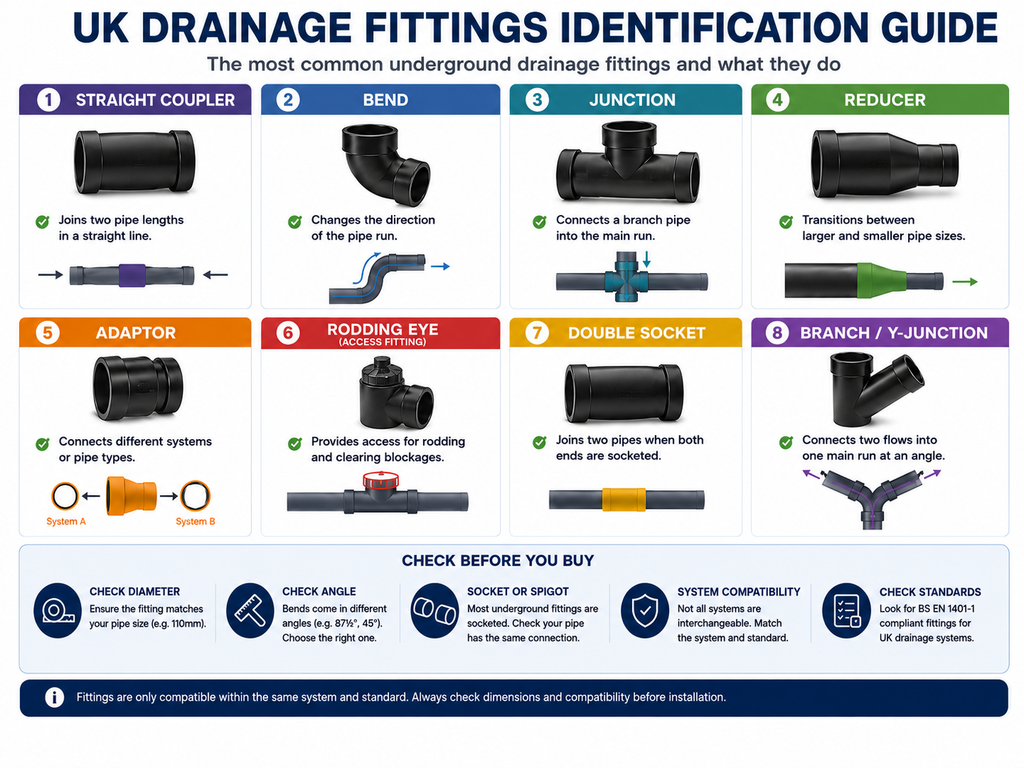
What Drainage Fittings Actually Do
Drainage fittings are used to connect, direct, and adapt pipework within a drainage system. While pipes form the main runs, fittings ensure that water flows correctly between sections.
A typical drainage system uses fittings to:
- Change direction where pipe runs turn
- Combine flows from multiple sources
- Adapt between different pipe sizes
- Join sections of pipe securely
- Provide access for inspection or maintenance
Each fitting is designed to work within a specific system. Shape, angle, and connection type are not universal, which means fittings must match both the pipe size and the system they are part of.
Common Drainage Pipe Fittings: Names and Uses
Underground drainage fittings connect pipe sections, change the direction of a run, join incoming branches and provide access for inspection or maintenance. Knowing the names of the main fitting types makes it easier to identify an existing component or find a suitable replacement.
The table below covers the most common fittings used in UK domestic underground drainage systems.
| Fitting type | What it does | What to check before buying |
|---|---|---|
| Drainage bend | Changes the direction of a pipe run. Available in different angles and socket configurations. | Pipe diameter, bend angle, socket arrangement and required radius. |
| Branch or junction | Connects an incoming drainage pipe to a main run. | Pipe sizes, branch angle, connection arrangement and flow direction. |
| Coupler | Joins compatible pipe ends to extend or connect sections of a run. | Pipe outside diameter, material and joint type. |
| Slip coupler | Joins pipe sections during repairs where a conventional stopped coupler may be difficult to position. | Pipe compatibility, available movement and sealing arrangement. |
| Reducer | Provides a suitable transition between different pipe diameters. | Both connection sizes and whether the transition is appropriate for the system. |
| Drainage adaptor | Connects compatible components from different pipe materials or connection systems. | Exact materials, dimensions and joint requirements. |
| Gully or trapped gully | Collects incoming water and, where fitted with a trap, helps prevent drainage odours escaping. | Inlet arrangement, outlet diameter, trap requirements and intended use. |
| Rodding or access fitting | Provides a point for inspection, cleaning or clearing blockages. | Connection size, accessibility and position within the drainage layout. |
Many domestic underground plastic drainage systems use 110mm pipework, with 160mm systems also commonly available. However, choosing a fitting by its advertised diameter alone is not sufficient.
The component must also suit the pipe material, joint design and drainage arrangement.
How Drainage Fittings Differ in Practice
While fittings may appear similar, their design can affect how water flows through the system and how well components connect.
Angle and Flow Direction
The angle of a fitting influences how water moves through it. Gradual changes in direction generally maintain smoother flow than sharper angles, which can slow movement or increase the likelihood of blockages.
Size and Compatibility
Fittings must match the pipe size they connect to, but diameter alone is not always enough. Differences in joint design or system type can prevent fittings from sealing correctly.
110mm underground drainage is particularly common in UK domestic drainage systems, and many bends, junctions, couplers and access fittings are therefore sold as 110mm fittings. Larger and smaller drainage systems also exist, so the existing pipe should always be identified rather than assuming that it is 110mm.
The stated diameter is only part of the identification process. Check the pipe size together with the fitting type, socket or spigot arrangement and the system being connected before buying a replacement.
Connection Type
Most modern plastic underground drainage systems use socket-and-spigot connections with a rubber ring seal, commonly described as push-fit drainage. The pipe spigot pushes into the sealed socket of the adjoining fitting.
Do not assume that other pipe systems use the same connection method simply because their nominal diameter is similar. Soil and waste systems, for example, may use different push-fit or solvent-weld arrangements, so the correct adaptor may be required where one system meets another.
System Consistency
Fittings are typically designed to be used within a specific system range. Mixing components from different systems can lead to poor fit, reduced durability, or long-term maintenance issues.
Even when fittings share the same nominal size, differences in design between systems can prevent components from connecting securely.
Common Mistakes When Choosing Drainage Fittings
Many drainage issues arise from selecting fittings based on appearance or size alone, without confirming compatibility with the existing system.
Common mistakes include:
- Matching pipe diameter but not connection type
- Mixing fittings from different systems
- Using incorrect angles for direction changes
- Overlooking how multiple flows combine at junctions
- Replacing sections without identifying the full system
These issues can lead to restricted flow, leaks, or the need to replace components after installation.
Understanding drainage connections
A fitting may have one or more sockets designed to receive pipe ends, while other fittings have spigot ends intended to enter a compatible socket.
Common underground PVCu drainage systems typically use push-fit joints with appropriate seals. Other drainage applications use different joining methods, and fittings designed for one system should not be assumed compatible with another.
Flexible couplings and purpose-made adaptors can sometimes provide suitable transitions between different pipe materials, but the correct product depends on the application.
For more information about common pipe diameters, see our UK drainage pipe sizes guide.
How to Identify the Correct Drainage Fitting Before Buying
If you’re replacing an existing fitting, start by identifying its function and the system it connects to. A component that looks similar may not provide a compatible or reliable connection.
1. Identify what the fitting needs to do
Determine whether the component joins straight pipes, changes direction, connects a branch, adapts between sizes or provides maintenance access.
Use the table above to identify the most likely fitting type.
2. Confirm the pipe diameter and material
Check the existing pipe’s outside diameter where it is safely accessible. Establish whether you’re dealing with underground PVCu drainage, clay, cast iron or another system.
A nominal size is a starting point, not confirmation that the connection will fit.
3. Check the connection type
Examine whether the existing pipe or fitting has a socket, spigot end, sealing ring or another joint arrangement.
This distinction is particularly important when repairing an older system or joining components manufactured from different materials.
4. Check the angles and branch layout
For bends and junctions, identify the required angle and orientation.
The fitting must suit the drainage layout and allow the system to function correctly. Avoid substituting a different angle simply because it appears to fit the available space.
5. Look for markings and product information
Check accessible fittings for manufacturer names, product codes or size markings.
Where possible, compare photographs and dimensions with the manufacturer’s specifications before ordering.
6. Confirm the complete connection
Before buying, make sure the proposed fitting matches both sides of the connection, including any required seals, adaptors or compatible accessories.
If the original system cannot be identified confidently, ask a specialist drainage supplier to confirm the appropriate fitting.
For an overview of how underground pipework, inspection chambers and surface water connections relate to each other, see our UK drainage systems guide.
A note about land drainage
Perforated land drainage pipes, used for collecting water from the surrounding ground, are a different product category from conventional solid-wall underground foul and surface water drainage.
Their connectors and fittings should be selected for the specific land drainage system rather than assumed interchangeable with standard 110mm underground drainage components.
Viewing Compatible Drainage Fittings
Once the pipe size, connection type and system are identified, sourcing fittings from the same compatible range helps avoid mismatched components.
Ad – affiliate link
Know which drainage fitting you need?
View 110mm underground drainage pipes, bends, junctions, couplers and other compatible fittings from Professional Building Supplies.
If you would rather compare buying options first, see our guide on where to buy drainage supplies in the UK.