Downpipe size is easy to overlook when replacing or extending guttering, but choosing the wrong size can leave you with an outlet, bend or connector that simply will not fit.
In the UK, 68mm round and 65mm square downpipes are particularly common on domestic properties, but they are not the only sizes available. Smaller and higher-capacity rainwater systems use different pipe sizes, and the correct choice depends on the guttering system and outlet being connected.
This guide explains the common downpipe sizes used in the UK, what those measurements mean and how to identify an existing downpipe before buying replacement parts.
What Is the Standard Downpipe Size in the UK?
There is no single standard downpipe size used on every UK property.
For modern domestic plastic guttering, two of the most commonly encountered sizes are:
- 68mm round downpipe
- 65mm square downpipe
However, the correct downpipe is determined by the guttering system and its outlet rather than by choosing a supposedly standard size.
Smaller gutter systems may use narrower downpipes, while high-capacity systems can use considerably larger ones.
| Downpipe size | Shape | Typical application |
|---|---|---|
| 50mm | Round | Small rainwater systems, sheds and smaller roof areas |
| 65mm | Square | Common domestic square downpipe systems |
| 68mm | Round | Common domestic round downpipe systems |
| 80mm | Round | Higher-capacity domestic and larger rainwater systems |
| 110mm | Round | Very high-capacity rainwater systems and large roof areas |
These are common examples rather than universal UK standards. Available sizes and compatible fittings vary between rainwater systems and manufacturers.
The sizes above describe common system types rather than universal standards. Manufacturers can use different outlets, sockets and fitting designs even where the nominal pipe size appears to be the same.
What Does Downpipe Size Actually Mean?
Downpipe sizes are normally described using the nominal width or diameter of the pipe.
For a round downpipe, this is expressed as a diameter such as 68mm or 80mm.
Square downpipes are usually described by their nominal width, with 65mm square being common in domestic plastic rainwater systems.
The stated size is useful for identifying a pipe, but it does not prove that a replacement component will fit. The pipe shape, outlet design, socket arrangement and manufacturer’s system should also be checked.
Common UK Downpipe Sizes
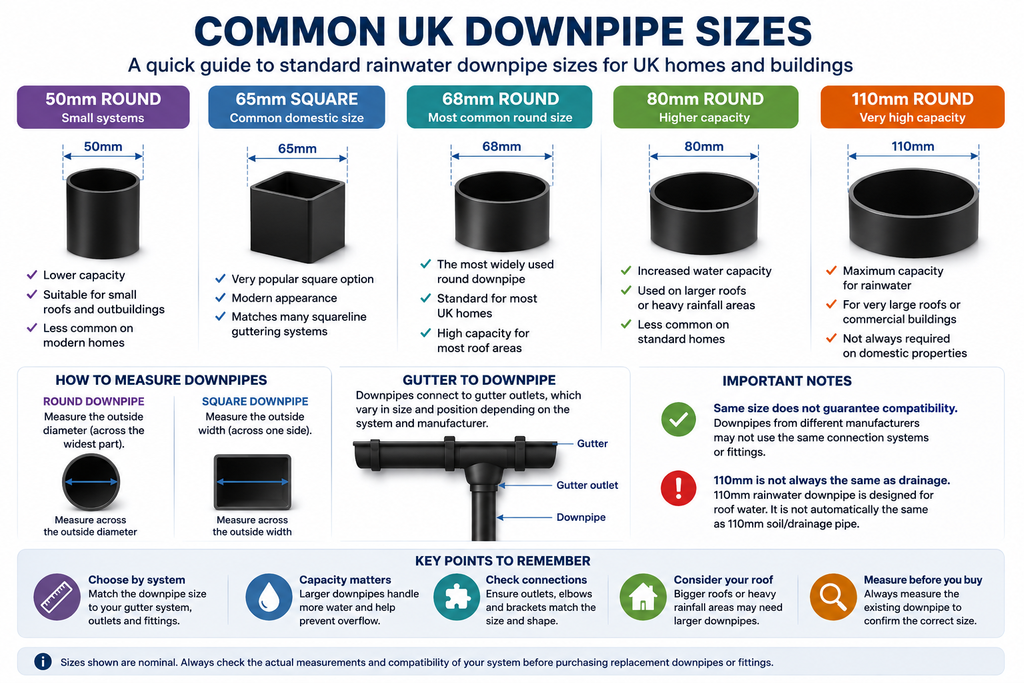
Common UK downpipe sizes including 50mm round, 65mm square, 68mm round, 80mm round and 110mm round rainwater pipes68mm Round Downpipe
68mm round downpipe is one of the most commonly encountered sizes on modern UK homes.
It is widely used with domestic plastic guttering systems and is available with the usual range of bends, shoes, sockets, branches, clips and outlets.
A 68mm measurement should not, however, be treated as proof that components from any two manufacturers can be mixed. If you are replacing a fitting rather than the complete system, identifying the existing manufacturer or system can prevent compatibility problems.
65mm Square Downpipe
65mm square downpipe is another common domestic size.
It is often associated with squareline guttering, although some other gutter profiles can also be designed to discharge into a square downpipe.
The pipe’s square shape makes it straightforward to distinguish from a round system, but visually similar square downpipes can still use different socket or fitting designs.
50mm Round Downpipe
50mm round downpipe is generally associated with smaller rainwater systems rather than full-size domestic guttering.
These compact systems may be used on structures with relatively small roof areas, such as sheds, outbuildings or other applications where a standard domestic rainwater system would be unnecessarily large.
If an existing pipe appears substantially narrower than a normal domestic downpipe, check the complete guttering system before assuming that a 68mm replacement is required.
80mm Round Downpipe
80mm round downpipe is used by some higher-capacity rainwater systems.
The larger pipe allows an appropriately designed gutter and outlet to move greater volumes of rainwater than a typical domestic system.
It should therefore be treated as part of a complete high-capacity system rather than simply as an oversized alternative to a 68mm pipe.
110mm Round Downpipe
Some very high-capacity rainwater systems use 110mm round downpipes.
These are much larger than the downpipes normally found on standard domestic guttering and are intended for systems handling substantially greater roof areas or rainwater volumes.
Although 110mm is also a familiar size in soil and underground drainage systems, this does not make those products interchangeable with a 110mm rainwater system. They are different systems designed for different purposes.
How Guttering Profile Affects Downpipe Size
The downpipe cannot be selected independently of the gutter.
Rainwater leaves the gutter through an outlet designed to connect the gutter profile to a particular downpipe system. The outlet therefore provides one of the most useful clues when trying to identify an existing installation.
For example, a guttering system may be designed around a 68mm round downpipe, a 65mm square downpipe or offer more than one compatible outlet option.
This is why identifying the guttering profile as well as the downpipe makes replacement parts easier to match.
If you are unsure which gutter shape is installed, see our guide to gutter profiles and how to identify them.
How to Measure an Existing Downpipe
Measuring the existing pipe is useful when the original system or manufacturer is unknown.
Measuring a Round Downpipe
Measure across the outside of the pipe from one side to the other at its widest point.
This gives you an approximate outside diameter and should make it relatively easy to distinguish between common sizes such as 50mm, 68mm and 80mm.
Do not rely on an extremely precise measurement from a tape measure alone. Nominal product dimensions, manufacturing tolerances and the shape of the pipe can result in small differences between the measurement you take and the size used to describe the product.
Measuring a Square Downpipe
Measure across the outside width of one flat face of the pipe.
A typical full-size domestic square downpipe may be described as 65mm, but again the measurement should be used as an identification clue rather than the only compatibility check.
Check the Outlet
If possible, inspect the outlet where the gutter connects to the downpipe.
Look at:
- Whether the connection is round or square
- The approximate outlet diameter or width
- Any manufacturer’s name or marking
- How the pipe connects to the outlet
- The shape of the gutter above it
The outlet often reveals more about the complete system than measuring the downpipe alone.
Does Downpipe Size Have to Match the Gutter?
The downpipe needs to be compatible with the outlet designed for the guttering system.
Simply fitting a larger pipe beneath a smaller outlet does not automatically increase the capacity of the rainwater system because the gutter and outlet may still restrict the flow.
Similarly, fitting a smaller downpipe to an outlet designed for a higher-capacity system may reduce how effectively rainwater can be carried away.
If capacity is the reason for changing the system, the gutter, outlet arrangement and downpipe should therefore be considered together.
For more information about gutter dimensions and capacity, see our UK guttering sizes guide.
Can Different Downpipe Sizes Be Connected?
Reducers and adaptors are available for some rainwater systems, but they should not be assumed to be universal.
Changing downpipe size can also affect how the outlet, bends, offsets, branches and shoes fit together.
If the purpose is simply to repair an existing installation, matching the current downpipe system is usually simpler than changing size part-way through the run.
Where a transition is genuinely required, use a fitting designed specifically for the systems being connected.
Common Downpipe Size Mistakes
Assuming Every Round Downpipe Is 68mm
68mm is common, but smaller and larger round rainwater pipes also exist.
Measure the existing pipe and check the gutter outlet before ordering replacement components.
Assuming Every Square Downpipe Is Interchangeable
Two pipes may both be described as square downpipes without using identical sockets, clips or fittings.
The manufacturer’s system remains important.
Choosing the Downpipe Before Identifying the Gutter
The downpipe receives water through the gutter outlet, so the gutter profile and outlet should normally be identified first when replacing an existing system.
Confusing Rainwater Pipe With Soil or Drainage Pipe
Similar nominal diameters do not mean different types of pipe belong to the same system.
Rainwater, soil and underground drainage products are designed for different applications and use different fittings and connection arrangements.
Increasing Pipe Size Without Checking the Outlet
A larger downpipe alone does not necessarily increase rainwater capacity.
The gutter profile, outlet size and system layout can all determine how much water reaches the pipe.
Narrowing Down the Correct Downpipe Size
If you are trying to identify an existing downpipe, work through the following checks:
- Identify the shape — round or square.
- Measure the pipe — check its approximate diameter or width.
- Inspect the gutter outlet — confirm what size and shape it is designed to accept.
- Identify the gutter profile — half round, squareline, ogee, Deepflow or another system.
- Look for manufacturer markings — these may appear on outlets, unions, brackets or other fittings.
- Compare the complete system — do not assume a matching nominal measurement guarantees compatibility.
Using all of these clues together is much more reliable than selecting a replacement from the pipe measurement alone.
Choosing Compatible Downpipe Components
Once the downpipe size and guttering system have been identified, replacement bends, sockets, clips, shoes and outlets can be selected from the same compatible system.
If the gutter itself still needs identifying, our guides to guttering sizes and gutter profiles explain the other measurements and shapes that can help narrow it down.
Matching the complete rainwater system rather than individual dimensions helps avoid buying components that look correct but will not connect properly.
Ad – affiliate links
Identified your downpipe size?
Choose the matching rainwater system below to view compatible downpipes, bends, shoes, outlets and fittings from Professional Building Supplies.
View 68mm round downpipes & fittings
View 65mm square downpipes & fittings
Need a different size or system? View all PVC guttering and rainwater systems .
For more buying options, see our guide to where to buy guttering in the UK.